

By Frans Sello waga Machate I Durban, South Africa
DURBAN — South African National Parks (SANParks) used a high-level breakfast roundtable discussion on Wednesday, to launch a series of centenary commemorations for the Kruger National Park (KNP), while committing to a future defined by inclusive conservation, scientific resilience and deeper partnerships with communities and the tourism industry.
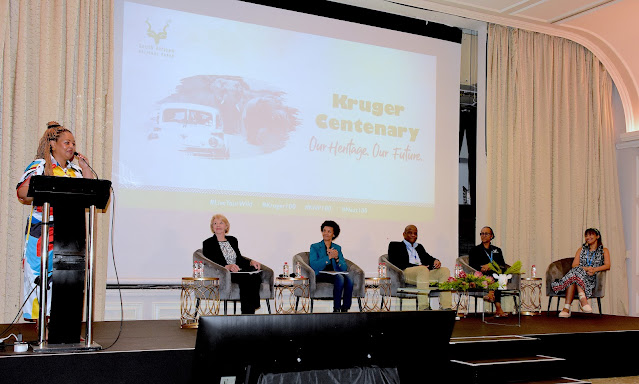
Held at the Maharani Hotel on Durban’s Marine Parade on the second day of Africa’s Travel Indaba, the ‘Conversations about Conservation‘ dialogue brought together conservation leaders, tourism stakeholders, historians and civil society to reflect on KNP’s first 100 years and to chart a bold path for the century ahead.
The Kruger National Park was proclaimed a national park on 31 May 1926. Over the past century, it has grown into nearly two million hectares of protected wilderness, forming the heart of the Great Limpopo Transfrontier Conservation Area. It is today a global benchmark for conservation science, environmental management and eco-tourism.
Interim SANParks Board Chairperson, Ms Beryl Ferguson, opened the dialogue by acknowledging both the achievements and the difficult legacies of the park’s history.
“Kruger’s history, like that of many protected areas globally, was shaped in an era of exclusion and dispossession, with lasting consequences for communities linked to this land,” Ferguson said. “Recognising this truth does not detract from conservation achievements; rather, it strengthens our resolve to ensure that the future is built differently with communities recognised as rightful partners in stewardship and shared benefit.”
She noted that in the democratic era, SANParks, together with government and community stakeholders, has worked to address these legacies through land restitution, co‑management arrangements, heritage recognition and benefit‑sharing initiatives.
“This ongoing work underscores a simple but enduring principle,” Ferguson said. “Conservation can only succeed, and endure, when it is inclusive.”
Ferguson also revealed that KNP had recently been recognised as among the world’s top ten national parks by Time Magazine, coming in at number three. The accolade, she said, is a testament to decades of dedicated conservation work and positions the park as a premier global destination.
SANParks CEO, Ms Hapiloe Sello, told the gathering that the ‘Conversations about Conservation’ dialogue, now in its second decade, serves as a “festival of ideas” to explore innovative approaches, strengthen partnerships and reaffirm shared responsibility.
“Over the past century, the Kruger National Park has evolved into nearly two million hectares of protected wilderness,” Sello said. “Its contribution to South Africa’s economy, job creation, research excellence, and international standing is both significant and enduring.”
She noted that 2026 is not only KNP’s centenary but also marks 100 years of the Wildlife and Environment Society of South Africa (WESSA) and the centenary year of renowned natural historian Sir David Attenborough. “Three distinct milestones, united by a shared commitment to the natural world,” Sello said.
The roundtable featured a distinguished panel of experts who explored the past, present and future of conservation in and around Kruger.
Ms Cindy Lee Cloete, CEO of WESSA, brought 15 years of experience in environmental learning and a passion for bridging the gap between natural surroundings and everyday lived realities. She emphasised the role of youth and civil society in shaping conservation consciousness. While Dr Nkabeng Mzileni, General Manager for Scientific Services (Cape and Arid Research Units) at SANParks, who oversees ecological research, conservation strategies and community‑partnered sustainability efforts. Outlined how science and innovation are guiding more responsive and effective park management in the face of climate change and biodiversity loss.
Emeritus Professor Jane Carruthers, environmental historian at the University of South Africa and author of the standard reference The Kruger National Park; a Social and Political History, provided a nuanced historical perspective on how conservation policies have evolved, urging honesty about exclusionary past practices while celebrating scientific and ecological milestones.
The Chairperson of the Tourism Business Council of South Africa (TBCSA), Mr Jerry Mabena, brought extensive expertise in tourism, marketing and property management. Articulated the tourism sector’s role in supporting conservation finance, creating local livelihoods and marketing protected areas responsibly.
Throughout the dialogue, SANParks leadership and panelists converged on several key commitments for KNP’s next century, such as deepening community inclusion, scaling up co‑management arrangements, land restitution partnerships and benefit‑sharing mechanisms to ensure that communities living adjacent to the park are recognised as co‑creators of value, not merely stakeholders. Strengthening scientific resilience, investing in research and monitoring to address climate change, extreme weather events; including recent floods and land‑use pressures.
Dr Mzileni stressed that science must guide adaptive management, expanding responsible tourism, working with the tourism industry to ensure that visitation supports conservation finance while enhancing visitor experiences. Adding to that, Mabena highlighted opportunities for cross‑border itineraries and the SADC Tourism UNIVISA to grow regional arrivals. Honouring heritage and correcting narratives.
Prof Carruthers also called for continued efforts to recognise indigenous histories and pre‑colonial relationships with the land, ensuring that Kruger’s story is told fully and truthfully.
On youth and environmental education Lee Cloete underscored WESSA’s role in engaging young South Africans in environmental learning, building a new generation of conservation stewards.
In her remarks, Ferguson thanked the panellists and urged the tourism and media communities to amplify Africa’s conservation story authentically.
“The narratives you shape, the destinations you elevate and the values you convey influence not only travel behaviour but conservation outcomes,” she said. “Your role in shaping perception, expectation and responsibility is both influential and indispensable.”
SANParks confirmed that the KNP centenary celebrations will continue throughout 2026, with a series of events, educational programmes and tourism promotions designed to honour the past while building an inclusive, resilient and globally competitive future for one of Africa’s most iconic protected areas.
