

By Frans Sello waga Machate I New Delhi, India
NEW DELHI — Chinese President Xi Jinping has called on BRICS countries to assume greater responsibility in shaping a fairer, more stable and more inclusive international order, unveiling a four-pronged vision for the grouping as it enters what he described as its third “Golden Decade” of cooperation.
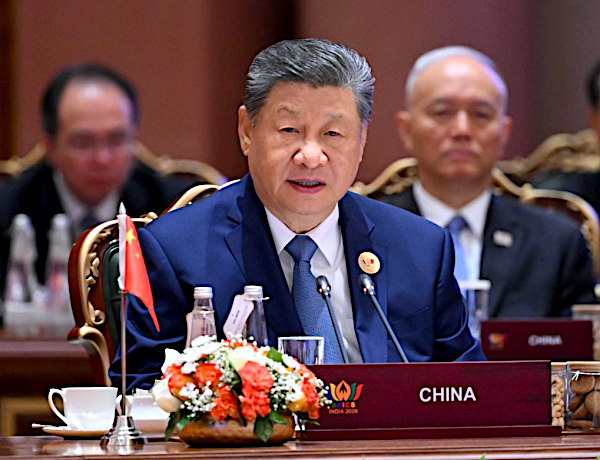
Addressing the First Session of the 18th BRICS Leaders Summit at Bharat Mandapam Convention Center in New Delhi, India on 12 September 2026, President Xi said the 20th anniversary of BRICS cooperation comes at a pivotal moment for the Global South and for the international system.
He argued that BRICS, following its historic expansion, has developed into the world’s most influential cooperation platform for emerging markets and developing countries and is entering a new stage of high-quality development through what he called “Greater BRICS Cooperation”.
Reflecting on the grouping’s two decades of development, Xi said BRICS countries had demonstrated self-reliance, solidarity and resilience while jointly responding to major challenges including the international financial crisis, the COVID-19 pandemic and climate change.
“These have been two decades of self-reliance,” Xi said, adding that BRICS countries had “upheld independence, actively explored development paths suited to their national conditions, and set an inspiring example for emerging markets and developing countries to grow strong through unity.”
He said BRICS had also become a source of stability amid global turbulence.
But Xi warned that the international environment is becoming increasingly difficult, with unilateralism and power politics gaining ground while multilateralism and the international order face mounting pressure.
“Unilateralism and power politics are rearing their ugly heads. Multilateralism and the international order are under strain,” he said, warning that “the peace, development, security and governance deficits keep widening.”
Against this backdrop, Xi said he had put forward the Global Development Initiative, Global Security Initiative, Global Civilization Initiative and Global Governance Initiative precisely to address these deficits and advance the building of a better world.
“BRICS countries must stand firmly on the right side of history, act as pioneers of our times, steer the international order toward greater fairness and equity, and work together to build a community with a shared future for mankind,” Xi said.
At the heart of Xi’s address was his proposition that BRICS should become a group of “pioneering forces” by embracing four strategic responsibilities.
First, he called on BRICS countries to become pioneers in fostering innovative development, with science and technology; particularly artificial intelligence, playing a central role in the next phase of cooperation.
“The new-round revolution in science and technology and industrial transformation, epitomized by artificial intelligence, is gathering pace and reshaping the global development landscape,” Xi said. “BRICS countries must seize the initiative.”
His call places AI at the centre of a broader BRICS strategy for technological advancement, industrialisation and economic development, particularly among developing countries. The Chinese President called for stronger BRICS cooperation in AI, including open-source development, openness and win-sharing, while urging members to elevate practical cooperation to “new and higher heights”.
He pointed to China's work with various parties to establish the World Organization for Artificial Intelligence Cooperation and its efforts to build an International Center for Applied AI Cooperation for BRICS and other partners.
“This provides an important platform for enhanced AI collaboration, especially among Global-South nations,” Xi said, inviting all BRICS members to take an active part.
President Xi then proposed the BRICS Initiative on Empowering New-Type Industrialization through Artificial Intelligence, saying China was prepared to work with other members to deliver more research and development and application results while deepening industrial-chain and supply-chain cooperation.
The proposal places technological innovation at the centre of Xi’s vision for the next phase of BRICS development; linking AI not merely to digital transformation, but to industrialisation, productive capacity and economic development across the Global South.
Xi also warned against efforts to fragment global production networks.
“Facts will prove that ‘decoupling and severing supply chains’ cannot hold back our development,” he said. “‘Small-yard, high-wall’ practices only serve to imprison oneself and fragment the world.”
His second proposition was for BRICS countries to become pioneers in upholding peace and stability. He said the world remains far from tranquil and attributed the instability fundamentally to the weakening of the post-war international order and ineffective observance of the purposes and principles of the UN Charter.
He urged members to promote a vision of common, comprehensive, cooperative and sustainable security, oppose Cold War mentality and bloc confrontation, and reject violations of sovereignty and interference in other countries’ internal affairs.
BRICS countries, he said, should also make constructive contributions to resolving international and regional hotspot issues and seek solutions addressing both their immediate symptoms and underlying causes. His remarks placed particular emphasis on the continuing instability in the Middle East and Gulf region, where he called for an end to the cycle of conflict and a permanent political solution.
“The ongoing conflict has inflicted heavy losses on peoples across the region and runs counter to the common interests of the international community,” Xi said.
He said relevant parties must commit themselves to a political settlement and work towards a “permanent and comprehensive cease-fire”. Xi called for de-escalation and a ceasefire as an immediate step towards peace, while stressing that lasting stability would require addressing root causes, rebuilding mutual trust among regional states and forging a new security architecture.
“It is vital to tackle root-cause problems, rebuild mutual trust among regional states and forge a new security architecture,” he said.
He also reiterated that the Palestinian question remains at the heart of the Middle East crisis.
“Its fundamental solution lies in implementing the two-state solution and realizing peaceful co-existence between Palestine and Israel,” he said, adding that China was ready to work with fellow BRICS members to contribute to peace and tranquillity in the Middle East and Gulf region.
The third BRICS “vanguard”, according to Xi, should be advancing exchanges among civilizations.
He called on the grouping's diverse societies and civilizations to coexist with tolerance while promoting common human values, intercivilizational exchanges and mutual learning.
“The beauty of a fine soup lies in blending diverse ingredients,” Xi said, using the metaphor to underline the value of diversity and coexistence.
He said BRICS countries, as inheritors of ancient civilizations and cradles of pluralistic cultures, should serve as a space where different civilizations can coexist in tolerance. And called for stronger cooperation in culture, tourism and education, increased youth exchanges and more frequent interaction between peoples.
Xi also proposed using BRICS platforms to share governance experiences and strengthen people-to-people understanding, saying these efforts could generate positive energy for stable state-to-state relations.
The fourth proposition he made is for BRICS countries to become pioneers in reforming and improving global governance. He stated that the type of global governance system built today will have profound consequences for humanity's future.
“What kind of global-governance system we build will shape the future of humanity,” Xi said.
BRICS, he said, should keep pace with the trend towards greater democracy in international relations and promote a more just and equitable global governance system. He reaffirmed the importance of the United Nations and opposed withdrawal from treaties, treaty-breaking and attempts to discard existing international arrangements and start again.
On trade, Xi called for support for the multilateral trading system centred on the World Trade Organization, together with WTO reform, opposition to arbitrary tariff imposition and resistance to protectionism.
“We should lead global-governance rule-making in new domains such as cyberspace, outer space and the deep sea, and amplify the voice of Global-South countries,” he said.
His four-vanguard proposition therefore goes beyond expanding economic cooperation among BRICS members. It presents the enlarged BRICS grouping as a potential platform through which developing and emerging economies can exercise greater collective influence over the rules, institutions and priorities shaping the international system.
The emphasis on development, security, civilization and governance mirrors the four global initiatives advanced by China, creating a broad framework that links economic development with technological innovation, peace and stability, cultural understanding and institutional reform.
For the Global South, the significance lies particularly in Xi's call for BRICS countries to amplify their collective voice in international affairs and help steer global governance towards greater fairness and equity. His message also comes against a geopolitical backdrop in which the principles of multilateralism, sovereignty, international law and the established international order are increasingly contested.
Xi therefore urged BRICS members to stand together in defending multilateralism and resisting unilateralism and power politics. His warning was direct that: the grouping must act as a collective force capable of contributing to a more balanced international system rather than allowing divisions to weaken the voice of the Global South.
As BRICS marks 20 years of cooperation, Xi said the experience of the past two decades had demonstrated that solidarity and cooperation are the “wellspring of BRICS progress.” He called on members to treat one another with candour, seek common ground while reserving differences, respect each other's core concerns, strengthen mutual understanding through communication and dialogue, and properly manage differences to ensure steady and sustained cooperation.
“We need to treat each other with candour, seek common ground while reserving differences, respect each other’s core concerns, enhance mutual understanding through communication and dialogue, properly manage differences, and ensure steady and sustained BRICS cooperation,” Xi said.
The timing is significant; with BRICS having undergone historic expansion and developed a broad, multi-tiered cooperation architecture covering trade, investment, finance, science and technology and other fields, Xi sees the grouping as entering a qualitatively different phase.
China will assume the BRICS chairmanship in 2027 and host the 19th BRICS Summit. President Xi said that China would use the opportunity to work with all partners to build consensus, shape the future and usher in the third “Golden Decade” of BRICS cooperation, with the ultimate objective of creating a stronger prospect of prosperity and progress.
“China will work with all partners to build consensus, shape the future, usher in the third ‘Golden Decade’ of BRICS cooperation, and jointly create a bright prospect of prosperity and progress,” He said.
His New Delhi address thus places BRICS at the intersection of some of the defining questions of the contemporary international system: who drives technological innovation, how development is shared, how conflicts are resolved, how international law is upheld and who gets a meaningful voice in global governance.
For China, the answer lies in a stronger and more united Global South, with BRICS serving as an increasingly influential platform for practical cooperation and collective action.
For the expanded BRICS, Xi's four-vanguard proposition offers a strategic roadmap: innovate for development, stand for peace, promote civilizational understanding and reform global governance.It is a vision that seeks to move BRICS beyond being simply a grouping of emerging economies towards a more consequential force in shaping the direction of global development, security and international relations in its third decade.
