
By Frans Sello waga Machate I Durban, South Africa
DURBAN — President Cyril Ramaphosa officially opened Africa’s Travel Indaba 2026 on Tuesday at the Inkosi Albert Luthuli International Convention Centre in Durban (ICC), declaring that tourism is no longer in a recovery phase but in a sustained growth period, and urging African nations to embrace seamless travel to unlock the continent’s full potential.
Addressing more than 1,200 exhibitors and 1,000 buyers from across the globe in the ICC, Ramaphosa said record-breaking arrival figures proved that “Africans are choosing Africa.”
South Africa welcomed 10.5 million international visitors in 2025, the highest number ever recorded, according to figures cited by both the president and Tourism Minister Patricia de Lille.
“Tourism is more than a sector of the economy. It is a living expression of who we are as a people,” Ramaphosa said.
Three‑quarters of those arrivals came from the SADC region, a statistic the president described as both encouraging and instructive. “This tells us something important: Africans are choosing Africa,” he said.
To build on that momentum, he confirmed that South Africa is working with neighbouring countries to advance the SADC Tourism UNIVISA, a single‑visa regime that would allow tourists to move freely across member states.
“When you market South Africa, you should be able to say that from here, you can also travel to destinations such as Victoria Falls and other attractions across the continent,” he said, urging stakeholders to stop competing in isolation and instead promote the continent as a single, world‑class destination.
Ramaphosa also used his address to challenge persistent negative narratives about Africa.
“Too often, global narratives about Africa tend to focus on all the negative things. What we now need to do is change that narrative, and tourism is the instrument that we can use. It is the colour that we can put to our continent.”
‘We are no longer speaking recovery, we are speaking growth’
Minister De Lille echoed the president’s optimism, declaring that the industry had moved decisively into a growth phase.
Citing the latest Tourism Satellite Account from Statistics South Africa, she said tourism directly employed 954,000 people in 2024 and contributed 4.9% to the country’s GDP.
“With a record‑breaking 10.5 million international arrivals in 2025, we are no longer speaking recovery, we are speaking ‘growth’,” De Lille said.
She pointed to several major infrastructure investments as evidence of rising confidence in the sector. These include; a R24‑billion expansion of the V&A Waterfront in Cape Town, a R10.5‑billion injection into the new Winelands Airport and a R2.1‑billion Club Med Beach & Safari Resort in KwaZulu‑Natal, set to open in July, which she described as “a bastion of successful public‑private partnership.”
De Lille also highlighted recent public‑sector tourism projects, including the R82‑million upgrade of the Cape Agulhas Lighthouse precinct, at Africa’s southernmost tip and the R120‑million SANParks’ Kgodumodumo Dinosaur Interpretation Centre in the Free State’s Golden Gate Highlands National Park, where the world’s oldest dinosaur embryo (200 million years old) was discovered. Since its launch in June 2025, nearly 90,000 people have visited the centre.
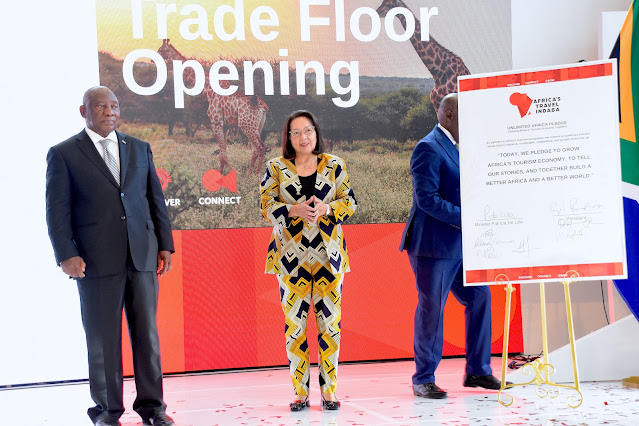
A central moment of the opening ceremony was the collective recital and signing of the Africa’s Travel Indaba pledge, which states: “Today, we pledge to grow Africa’s tourism economy, to tell our stories, and together build a better Africa and a better world.”
De Lille reminded delegates that the very venue where the Indaba is being held which is the Durban International Convention Centre was where the African Union was launched in July 2002, succeeding the Organisation of African Unity.
Looking ahead, De Lille announced that Africa’s Travel Indaba owned by South African Tourism and widely regarded as one of the top three travel trade shows globally will undergo a significant revamp.
“We are looking for sponsors and partners to journey with us in 2027,” she said, calling on creatives and stakeholders to submit their ideas to proposals@southafrica.net.
The event has previously won the World Travel Award for Africa’s best travel and tourism show.
De Lille said the business events sector remained a critical job creator. In the 2025/26 financial year, the South African Conventions Bureau submitted 100 international MICE (Meetings, Incentives, Conferences, and Exhibitions) bids and secured 52, “another vote of confidence in our world‑class MICE infrastructure.”
South Africa will host the SADC Heads of State Summit in Durban in August 2026, followed by a special meeting of the World Economic Forum in 2027 and the Cricket World Cup in 2027, co‑hosted with Zimbabwe and Namibia.
President Ramaphosa added that during South Africa’s recent G20 Presidency, the first G20 Leaders’ Summit on African soil the country piloted an Electronic Travel Authorisation (ETA) system, which is now being rolled out to simplify travel. He also noted that new visa reforms, including a Digital Nomad Visa, are designed to make South Africa more accessible and competitive.
The president praised young entrepreneurs and innovators who are reshaping the visitor experience through apps, safety tools, and digital platforms for township tourism.
“Our youth are not waiting for the future. They are creating it now,” he said.
Closing the opening session, Ramaphosa invoked the spirit of pan‑Africanism and the African Union’s Agenda 2063, which aims to enable the free movement of all African citizens.
“All we have to do is be bold and focused, and we will have Africa brimming with tourist destinations and the tourists will come in their millions. They will come back to their original home, which is the continent of Africa.”
Africa’s Travel Indaba 2026 runs until Thursday, 14 May. The event is expected to generate significant economic spin‑offs for Durban, following a 2025 edition that contributed R610.6 million to South Africa’s GDP and supported more than 1,100 jobs.
