


From Vision to Global Action
By Frans Sello waga Machate I Beijing, China
BEIJING — China’s Foreign Minister Wang Yi has reaffirmed Beijing’s commitment to placing development at the centre of global governance, urging the international community to strengthen multilateral cooperation, accelerate progress toward the United Nations Sustainable Development Goals (SDGs), and give greater prominence to the priorities of developing countries amid an increasingly volatile geopolitical landscape.
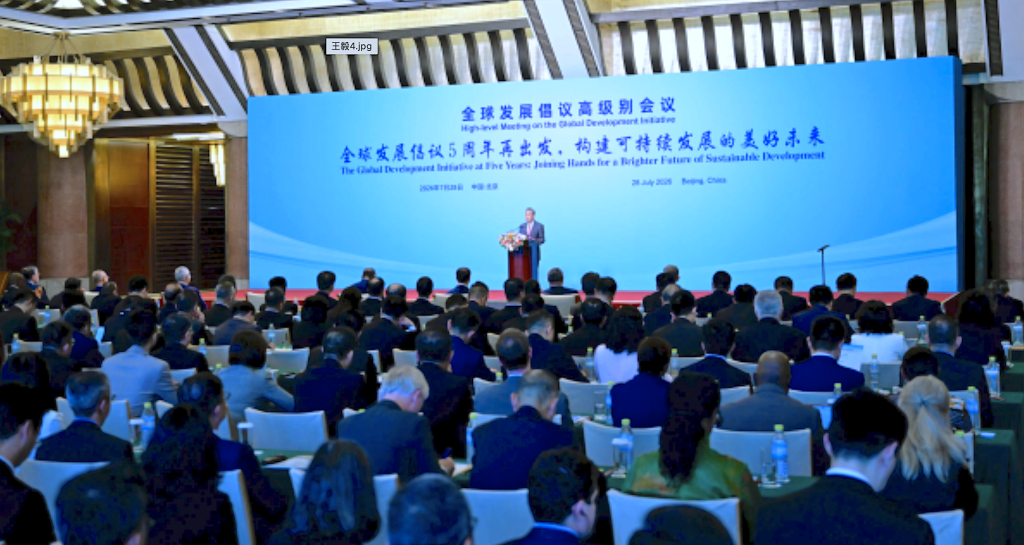
Speaking at the High-Level Meeting on the Global Development Initiative (GDI) in Beijing on 28 July 2026, Wang described the initiative as an increasingly important international platform for promoting inclusive growth, South-South cooperation and sustainable development during what he characterized as “a period of transformation and turbulence” in world affairs.
The meeting, jointly hosted by China’s Ministry of Foreign Affairs, the China International Development Cooperation Agency (CIDCA) and the United Nations development system in China, commemorated the fifth anniversary of the Global Development Initiative under the theme “The Global Development Initiative at Five Years: Joining Hands for A Brighter Future of Sustainable Development.” Senior United Nations officials, diplomats from member states of the Group of Friends of the GDI and representatives of UN agencies participated in the gathering.
Reflecting on the initiative’s progress since its launch by Chinese President Xi Jinping at the 76th Session of the United Nations General Assembly in 2021, Wang said the GDI has evolved from a Chinese proposal into what he described as a widely supported international development framework.
According to Wang, more than 130 countries and international organizations have expressed support for the initiative, while nearly 100 countries and international and regional organizations have signed cooperation documents with China under the GDI framework. He also noted that the Group of Friends of the GDI has grown to 88 member countries, providing an increasingly influential platform for advancing development cooperation within the UN system.
He said China has also established more than 30 cooperation mechanisms and platforms supporting Global South countries, while development financing initiatives, including the China-UN Peace and Development Fund and the Global Development and South-South Cooperation Fund, have mobilized more than US$23 billion.
Those resources, Wang noted, have supported over 1,800 “small and beautiful” livelihood projects and provided professional training opportunities for more than 200,000 people, with programmes benefiting communities in more than 120 countries. Examples include poverty alleviation initiatives using Juncao technology, the Sustainable Development Science Satellite-1 (SDGSAT-1) and the MAZU platform for meteorological early warning and disaster risk reduction.
While the meeting focused on sustainable development, Wang’s remarks also reflected the broader geopolitical realities confronting the international community.
He argued that delays in implementing the 2030 Agenda for Sustainable Development, widening disparities between developed and developing countries, and growing international instability have reinforced the importance of prioritizing development within global governance.
“The implementation of the 2030 Agenda for Sustainable Development has seen serious delays, the North-South gap keeps widening, and the cause of global development faces grave challenges,” Wang said, adding that these trends underscore the “pressing relevance” of the Global Development Initiative.
Rather than framing development solely as an economic objective, Wang presented it as a stabilizing force capable of reducing global inequality, supporting peace and strengthening international cooperation at a time of heightened geopolitical competition.
Wang outlined four strategic priorities that China believes should guide future international cooperation under the Global Development Initiative.
He called for stronger solidarity and cooperation to create a peaceful international environment conducive to development. He reaffirmed China’s support for a United Nations-centred international system, advocating reforms that strengthen the organization’s development role while advancing the interests of developing countries.
Wang urged countries to accelerate implementation of the Sustainable Development Goals by placing development at the centre of the international agenda. China, he said, will continue sharing financial, technological and development resources while expanding bilateral, multilateral and trilateral cooperation aimed at reducing uneven global development.
He emphasized innovation and technological cooperation, particularly in addressing the widening digital and artificial intelligence divide between developed and developing nations.
In this context, Wang highlighted the recent launch of the World Artificial Intelligence Cooperation Organization (WAICO) by China and 28 partner countries, describing it as an important response to calls from the Global South for more inclusive AI governance and development cooperation. He said China stands ready to deepen innovation partnerships to ensure developing countries benefit from emerging technologies rather than being left behind.
Wang stressed the importance of strengthening multilateralism and reforming global economic governance. He called for improvements to international financial institutions, greater development financing and better policy coordination as the United Nations prepares discussions on the post-2030 global development agenda.
He also urged developed countries to honour their development financing commitments and ensure that future international development frameworks better reflect the priorities of the Global South.
Concluding his address, Wang linked China’s own economic development to its international development agenda.
He noted that China recorded 4.7 percent GDP growth during the first half of 2026, despite global energy pressures and disruptions to international industrial and supply chains, arguing that China’s economic stability provides valuable certainty in an increasingly uncertain world.
“No matter how the international landscape may evolve,” Wang said, “China will continue to honor its responsibilities as a major country” while advancing implementation of the Global Development Initiative and sharing development opportunities with countries working toward “a community with a shared future for humanity.”
The High-Level Meeting concluded with participating countries and United Nations representatives commending the achievements made during the GDI’s first five years.
According to the meeting’s official summary, participants recognized that the initiative aligns with the purposes of the UN Charter, helps restore development to the centre of the international agenda and creates meaningful opportunities for countries of the Global South. Delegates also expressed their willingness to deepen development cooperation with China, support multilateralism and work collectively toward sustainable development, peace and shared prosperity.
Against a backdrop of persistent geopolitical tensions, slower global economic growth, climate-related challenges and widening development inequalities, the meeting reinforced China’s message that development should remain a central pillar of international cooperation.
Wang’s remarks positioned the Global Development Initiative not only as a long-term development programme but also as part of a broader vision for strengthening multilateralism and expanding the voice of developing countries within the evolving global governance architecture.
