


By Frans Sello waga Machate | Pretoria, South Africa
PRETORIA — The Chinese Embassy in South Africa on Wednesday hosted a high-level reception in Pretoria to commemorate the 77th anniversary of the founding of the People’s Republic of China, bringing together senior South African government representatives, former President Kgalema Motlanthe, members of the diplomatic corps, business leaders, civil society representatives and the Chinese community.
The National Day reception, held on 30 September ahead of China’s National Day on 1 October, provided a platform to reflect on China’s development trajectory while highlighting the depth and expanding scope of relations between South Africa and China. More than 600 guests attended the commemoration, according to the Chinese Embassy.
In his address, Chinese Ambassador to South Africa Wu Peng linked China’s development experience to its expanding international partnerships, saying the country’s progress over the past 77 years had opened “new prospects for the great rejuvenation of the Chinese nation”.
Wu said China’s development had been accompanied by advances in scientific and technological innovation and improvements in people’s lives, noting that China’s gross domestic product exceeded 140 trillion yuan last year.
Looking beyond China’s domestic development, Wu invoked the African philosophy of Ubuntu, saying, “I am because we are,” and emphasised that China’s development and global development reinforce one another.
He said China remained committed to “high-standard opening up, high-quality development and world peace”, while President Xi Jinping’s four Global Initiatives were contributing what he described as Chinese wisdom and solutions to common global challenges.
Wu also placed strong emphasis on the China-Africa relationship, highlighting China’s implementation from 1 May 2026 of zero-tariff treatment for qualifying products from African countries with which it has diplomatic relations. South African authorities have confirmed the implementation of China’s temporary zero-tariff preference scheme for qualifying South African exports, subject to rules of origin and other requirements.
The ambassador said China had remained South Africa’s largest trading partner for 17 consecutive years, while bilateral trade had surpassed $53 billion and Chinese direct investment in South Africa had exceeded $12 billion.
He also highlighted the recent signing of the Protocol for the Export of South African Cherries to China, describing it as another example of expanding economic cooperation.
South African Tourism Minister Patricia de Lille, delivering congratulatory remarks on behalf of the South African government, described the bilateral relationship as one characterised by “political trust, mutual respect, and solidarity”.
De Lille said the relationship had continued to expand since diplomatic ties were established in 1998, covering political, economic, social, cultural and developmental cooperation, including people-to-people exchanges.
She pointed to recent high-level engagements, including the ninth session of the South Africa-China Bi-National Commission, Deputy President Paul Mashatile’s working visit to China, and cooperation in the energy sector.
De Lille also highlighted South Africa and China’s cooperation on artificial intelligence, saying South Africa had joined China as a founding member of the World Artificial Intelligence Cooperation Organisation.
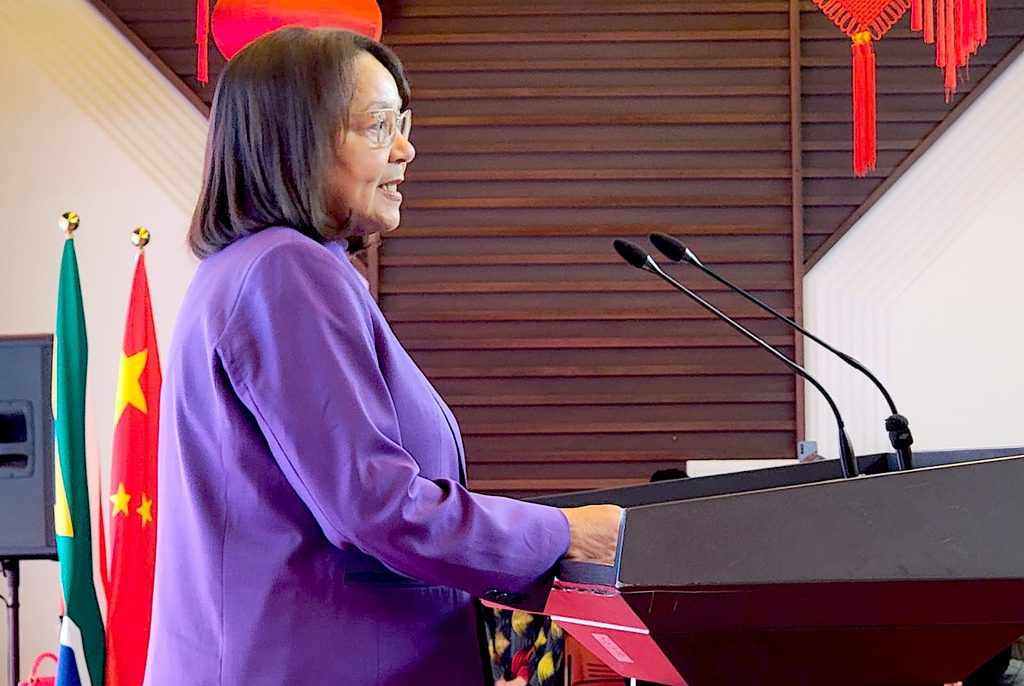
Economic cooperation featured prominently in De Lille’s remarks. She said South Africa had recently signed the China-Africa Economic Partnership Agreement in Beijing and noted growing exports of South African agricultural products to China, including cherries, following the signing of the Cherry Protocol.
Tourism, too, was identified as an important area for expanding people-to-people links. De Lille said South Africa was working to make visas more accessible to Chinese visitors, strengthen direct air connectivity and equip tourism practitioners with Mandarin-language and cultural skills. She said 18,031 Chinese travellers visited South Africa between January and July 2026.
Former President Kgalema Motlanthe brought a historical and developmental perspective to the commemoration, stating that the relationship between South Africa and China extends beyond contemporary diplomatic and commercial ties.
Motlanthe recalled historical links between China and Africa’s liberation movements, including contacts involving the African National Congress and Chinese revolutionary leadership, as well as military training provided to members of Umkhonto weSizwe in China.
He said these historical bonds were “not created merely by diplomatic calculation” but were rooted in solidarity between peoples who had experienced oppression and struggles for liberation.
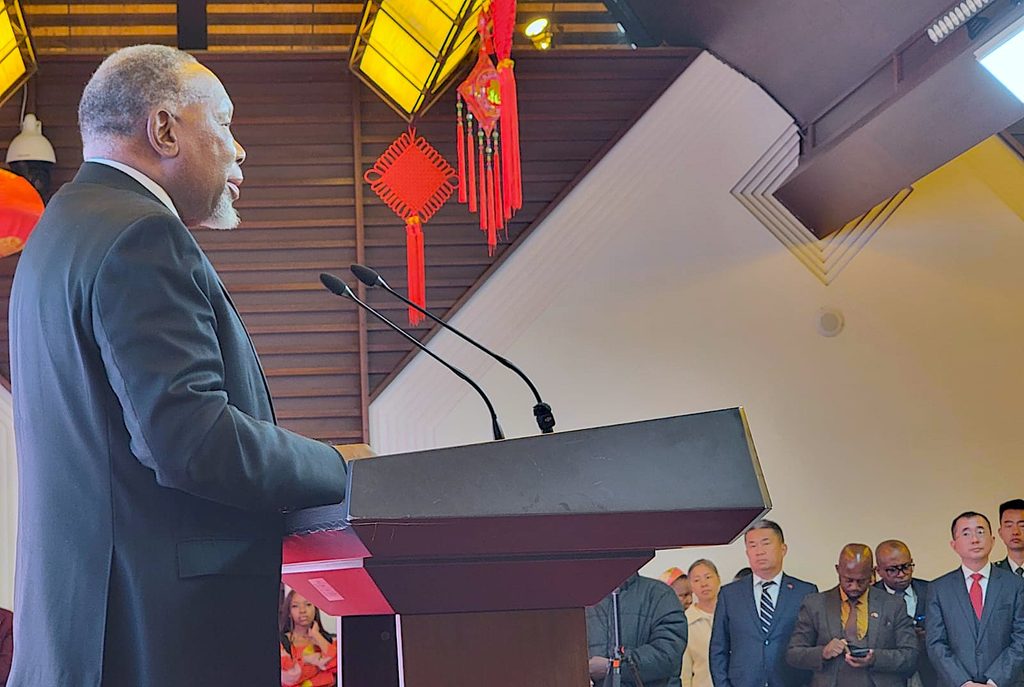
Motlanthe further argued that political freedom and economic emancipation could not ultimately be separated, stressing the importance of industrialisation, infrastructure, education, technological advancement, scientific capacity and economic inclusion.
“For Africa, this remains an unfinished historical task,” he said, warning that the continent’s continued dependence on exporting raw materials while importing higher-value finished products required a transformation of production, industrialisation and investment in science, technology and human capabilities.
He called for stronger people-to-people relations between South Africa and China, including greater interaction among universities, municipalities, businesses, professional associations, civil society organisations, cultural institutions and youth formations.
The reception also featured cultural performances by South African and Chinese groups, showcasing music and cultural traditions from both countries and providing a celebratory dimension to the diplomatic gathering.
In his closing remarks, Wu said China and South Africa, despite being thousands of kilometres apart, remained “good friends, good partners and good brothers”, sharing what he described as a common future.
With China and South Africa set to successively hold the BRICS chairmanships over the next two years, Wu said the two countries stood ready to work together to take BRICS “to new heights” and create greater opportunities for the Global South.
Motlanthe similarly called for the next chapter of South Africa-China relations to contribute to “a shared future for humanity” and an international order founded on equality among nations, mutual respect and shared human dignity.The commemoration thus brought together history, diplomacy, trade, technology, tourism and culture, underscoring the increasingly broad range of cooperation between South Africa and China as both countries look towards a new phase of their strategic partnership.
