


Mbalula Pays Tribute To Fallen ANC Comrades As Angola Repatriation Begins
By Frans Sello waga Machate I Pretoria, South Africa
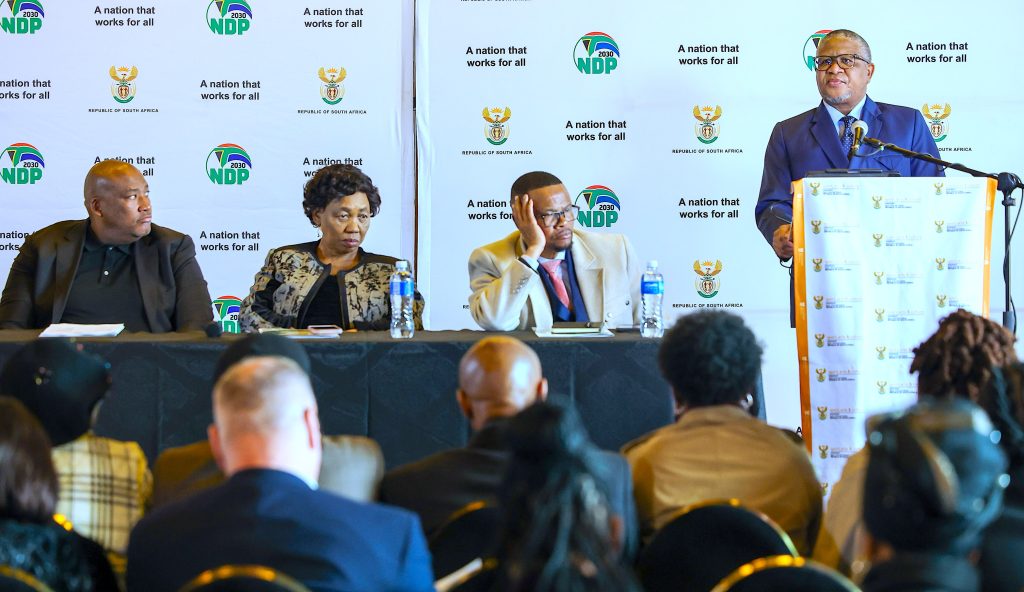
PRETORIA — Standing at Freedom Park, a place built to hold the names of those the nation must never forget, African National Congress Secretary-General Fikile Mbalula earlier this morning delivered a stirring address as the government launched the second phase of its Exile Repatriation Programme, aimed at bringing home hundreds of liberation heroes who fell in Angola.
“We gather this morning at Freedom Park, a place built to hold the names of those our nation must never forget, to launch a programme that has waited far too long. Today we continue, in earnest, the work of bringing home the sons and daughters of South Africa who marched into exile in the 1960s, 70s and 80s and who never returned,” Mbalula said.
The briefing, which also featured Minister of Sport, Arts and Culture Gayton McKenzie, Minister of Defence and Military Veterans Angie Motshekga, and Deputy Minister of Justice and Constitutional Development Andries Nel, marked a pivotal moment in the country’s journey to honour those who sacrificed everything for freedom.
Mbalula recounted the painful history that drove thousands of young South Africans into exile. “When the apartheid state banned the African National Congress in 1960 and closed off every lawful avenue of resistance, our movement took the painful decision to take up arms. Thousands of young South Africans, many of them still teenagers who had marched in Soweto, in Alexandra, and in many other townships in June 1976, left everything they knew and crossed into exile to keep the flame of liberation alive,” he said.
It was in Angola, following that country’s own hard-won independence from Portuguese colonialism in 1975, that Umkhonto we Sizwe found the ground on which to train and to organise. Novo Catengue, which cadres came to call the University of the South, became the intellectual and military home of a generation until it was bombed by the apartheid air force in 1979.
“Our combatants moved further into Angola and continued, undeterred, to prepare for the day South Africa would be free. Not all of them lived to see that day. Some fell in confrontations with apartheid’s proxy forces. Some were lost to disease, to the sheer brutality of exile, far from the mothers and fathers who had no way of knowing what had become of their children,” Mbalula said.
The ANC Secretary-General paid special tribute to the people of Angola, who shared their independence with South African freedom fighters before their own state had even finished securing it. “President Agostinho Neto and the Popular Movement for the Liberation of Angola (MPLA) opened their newly liberated soil to Umkhonto we Sizwe at a moment when Angola itself was under attack from apartheid-backed forces,” he said.
The bond between the two nations found its fullest expression at Cuito Cuanavale between 1987 and 1988, where Angolan, Cuban and South African liberation forces stood together against the apartheid war machine in what became the largest conventional battle fought on African soil since the Second World War. The outcome of that campaign hastened the independence of Namibia and hastened, too, the collapse of apartheid.
“It is not an exaggeration to say that the road from Cuito Cuanavale led, in a straight line, to the unbanning of our movement in 1990 and to the first democratic elections in 1994. We owe that outcome to the blood of Angolans, Cubans and South Africans mixed together on the same soil, and it is a debt the ANC does not forget,” Mbalula declared.
The repatriation programme forms the second phase of government’s Repatriation and Restitution of Human Remains and Heritage Objects Plan, with Angola as its immediate focus. According to Deputy Minister Nel, available records indicate that between 300 and 400 combatants of Umkhonto we Sizwe died in Angola during this period. Current assessments indicate that between 30 and 50 per cent of the deceased may be recoverable.
Mbalula addressed the profound question that has haunted families for decades. “Did our combatants die in vain in foreign lands far from home? We answer, without hesitation, that they did not. Their blood nourished the tree that bore the fruits of our freedom,” he said.
He outlined the democratic gains that honour their sacrifice, a constitutional democracy built on the Freedom Charter’s promise that the country belongs to all who live in it; a Constitution and Bill of Rights that guarantee equality before the law; millions of houses built and millions of households connected to water and electricity; free basic education and no-fee schools; and a social grant system that reaches over eighteen million South Africans every month.
“None of this is the end of the journey, and we do not pretend that unemployment, inequality and poverty have been defeated. But it is the clearest demonstration of our commitment to make the promise of a better life for all a lived reality, honouring the sacrifice of our comrades in Angola’s camps and battlefields,” he said.
The ANC has walked this road with government from the outset, as the movement that maintained an operational presence in Angola throughout the years of exile and that holds much of the institutional memory this work depends on. Mbalula noted that the ANC holds the camp records, deployment lists and institutional memory without which the graves cannot be found.
The Umkhonto we Sizwe Liberation War Veterans (MKLWV), in a media statement issued shortly after the briefing, welcomed the planned second phase of the repatriation. “Angola did not only provide military bases for our Oldest Liberation Movement, they gave us broadcast facilities for Radio Freedom, the then Voice of the ANC and the People’s Army MK. The voice that carried courage and motivation into homes across South Africa,” the statement read.
The MKLWV said the planned Angolan repatriation “brings back painful but proud memories of the comrades we left behind in many graves in Angola” and saluted the leadership for fulfilling the promise made by President OR Tambo that all fallen cadres in faraway lands would be brought back to a free and democratic South Africa.
“This act of honour and mortal repatriation is a token of appreciation for the sacrifices made by the freedom fighters of Umkhonto we Sizwe and other liberation movements. It restores dignity. It brings closure to families who have longed for answers and who watched for years as the nation celebrated freedom while they carried the pain and sense of disappearance of their loved ones,” the MKLWV statement said.
Mbalula appealed to every family who lost a relative in Angola during those years to come forward through the platforms government has put in place. “Nothing in this process can proceed without you,” he said.
“To the families gathered here, and to those still waiting at home for news of a parent, a sibling, a child; the African National Congress stands with you, as it has stood with the people of Angola since the 1970s, and we will not rest until every story that can be told, is told, and every combatant who can be brought home, is brought home,” Mbalula concluded.
