

By Frans Sello waga Machate I Johannesburg, South Africa
JOHANNESBURG — Federal Minister for Foreign Affairs of Germany Dr Johann Wadephul has invoked the spirit of Nelson Mandela and the philosophy of Ubuntu in a wide-ranging address at the University of the Witwatersrand, calling for deeper cooperation between Europe and Africa in a fragmented world order.
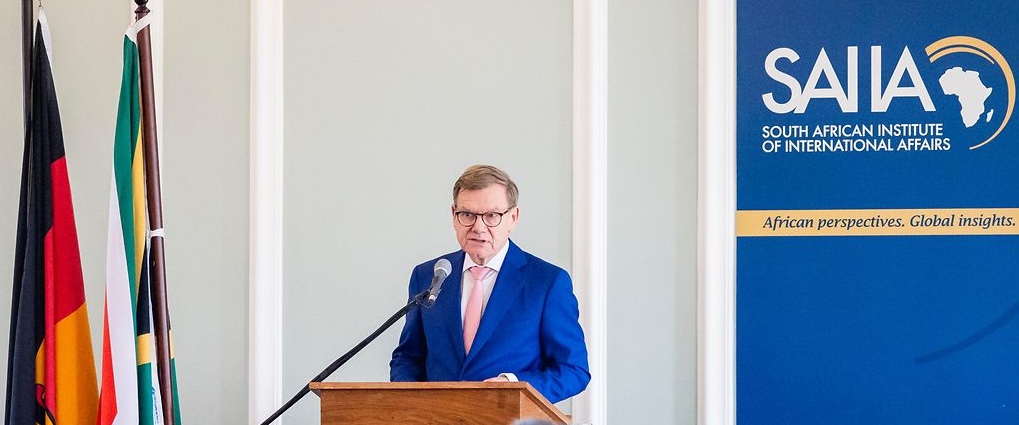
Speaking at the South African Institute of International Affairs (SAIIA) on Thursday, Wadephul reflected on the historic parallels between Germany’s reunification and South Africa’s transition from apartheid, while addressing pressing global challenges including the war in Ukraine, the crisis in Sudan and the future of multilateralism.
The address, titled “Verantwortung and Ubuntu – common German and South African perspectives in a fragmented world”, came at the conclusion of his four-day Africa tour that included stops in Mauritania and Nigeria before arriving in South Africa for bilateral talks with International Relations and Cooperation Minister Ronald Lamola and a courtesy call on President Cyril Ramaphosa.
Wadephul opened his remarks by recalling Nelson Mandela’s first visit to Germany in June 1990, just four months after his release from 27 years in apartheid prisons and only seven months after the fall of the Berlin Wall.
“My country was undergoing profound change and preparing to overcome more than four decades of division at that time,” Wadephul said. “In this spirit of profound change, our two nations shared the experience of a peaceful revolution. Reconciliation and reunification were social and political challenges that both our peoples wanted to solve.”
The German minister acknowledged the complex history of German-South African relations, noting that while there was considerable civil society support in Germany for the anti-apartheid struggle, German companies had cooperated with the apartheid regime and West German governments had maintained close relations with the country.
“Nelson Mandela knew this. And yet, he extended his hand in reconciliation. He wanted to build a friendship with Germany not overshadowed by the past. This became the basis for a friendship whose fruits we have been harvesting for more than 30 years now,” Wadephul said.
At the core of bilateral relations is the Bi-National Commission, established in 1996 following Mandela’s State Visit to Germany. The 12th meeting of the Commission, held in Berlin in April 2026, marked its 30th anniversary and the elevation of the relationship to a Strategic Partnership.
“To some, this might sound as empty political poetry. But it is not!” Wadephul said. “It reflects that from the very beginning, in 1995, our cooperation was indeed mutually beneficial. Our relationship has never been one-sided.”
He pointed to the more than 600 German companies operating in South Africa, employing over 100 000 people, and annual bilateral trade volume of €20.1 billion (approximately R375 billion). More than 300 000 German tourists travelled to South Africa in the last 12 months alone.
Through the newly adopted Joint Action Plan, signed by Lamola and Wadephul in Berlin, the two countries will systematically intensify cooperation along more than 90 concrete measures.
“What was set in motion between South Africa and Germany in the mid-1990s has not only endured, but has continued to grow and deepen,” he said.
Wadephul addressed the far-reaching effects of Russia’s war against Ukraine, noting that the conflict had shattered long-held illusions in Germany.
“The war has shattered long-held illusions, particularly in my own country: the belief that economic interdependence and trade would guarantee stable political relations. That war on the European continent had become a thing of the past. And it has profoundly shattered our sense of security,” he said.
He praised President Ramaphosa’s 2023 visit to Ukraine as part of an African leaders’ delegation, calling it an “historic example of African agency in a globalised world”.
“I believe that this historical initiative never received the recognition it deserves even beyond its symbolic value: African leaders travelling to Europe in an effort to help restore peace,” Wadephul said. “South Africa has long-standing experience in mediation and peace processes and chose to bring it to Europe. Europe should learn from that experience as we look to the future.”
The German minister highlighted the Sudan Conference hosted in Berlin in April 2026, which brought together 60 countries, representatives of over 50 non-governmental organisations and international organisations, as well as Sudanese civil-society actors.
“Sudan is suffering from the biggest man-made humanitarian catastrophe of our time. Yet it has not received the international attention it merits. It is our intention and our obligation to change that,” Wadephul said.
The conference helped mobilise urgently needed humanitarian support and enabled agreement on principles for a peaceful resolution of the conflict, subsequently endorsed by 22 states and organisations.
“Despite such considerable international pressure, peace has not yet returned to Sudan. It nevertheless remains our duty to continue working towards it, relentlessly and without losing hope! I am glad and relieved to know that our countries stand united in this regard,” he said.
Wadephul expressed concern about the state of multilateral institutions, particularly the United Nations.
“Today, the UN can no longer live up to its full potential because the very foundations of the UN system are increasingly being challenged,” he said. “In its current structure, the UN no longer reflects the realities of today’s world. Too often, it still represents a global order of the past and not of the present.”
He reiterated Germany’s support for permanent African representation on the UN Security Council.
“There can be no genuinely representative United Nations without permanent African representation on the Security Council,” Wadephul said.
He also addressed last year’s G20 Summit in Johannesburg, describing South Africa as an “indispensable member” of the forum.
“To exclude South Africa means sidelining an important African voice and a regional economic and political powerhouse. This can be in no one’s interest, as, particularly at a time of growing global economic uncertainty, we need more cooperation, not less!” he said.
Wadephul acknowledged the economic headwinds facing both countries, citing the conflicts in Ukraine and the Middle East and the disruption of shipping through the Strait of Hormuz and the Red Sea.
“I am firmly convinced that no country will be in a position to overcome challenges like these simply by making domestic adjustments. Today, foreign policy and domestic policy are inextricably linked,” he said.
He noted that for the African continent, three “F”s stand out: fuel, food and fertiliser.
The German minister acknowledged that the two countries do not see eye to eye on every issue.
“Just because we work so closely together doesn’t mean we have to agree on everything. Neither do we have to share all identical values nor hold the same political positions on every issue. Of course not!” he said.
“I am fully aware that some of Germany’s policies are questioned here in South Africa. Having said this, I see it as a symbol of true friendship and trust that we can see the world also through the eyes of the other. In some disputed matters we can agree to disagree. And at the same time keep on working together.”
He stressed that what matters is commitment to the same international principles and treating each other’s history, political context and national interests with respect and dignity.
Wadephul concluded by invoking the Ubuntu philosophy, expressing deep resonance with its core belief.
“Maybe this is why a core belief of the Ubuntu philosophy expressed in the words ‘Umuntu ngumuntu ngabantu’ resonates so much with me: A person is a person through other people, or, as it is often understood: I am because we are!” he said.
“I have come to understand that this idea profoundly shapes the way people in southern Africa see the world and act in it. It shapes the way people relate to one another. It reflects the respect we owe one another because we recognise that our lives are deeply interconnected.”
“And it is precisely this spirit of respect, of genuine interest in one another that must also guide partnerships between nations; like the one between South Africa and Germany,” Wadephul said.The address marked the culmination of a working visit that has reinforced the depth of a bilateral relationship anchored in shared democratic values, extensive economic ties and a common commitment to multilateralism; now elevated to a Strategic Partnership for the next chapter of cooperation between the two nations.
