

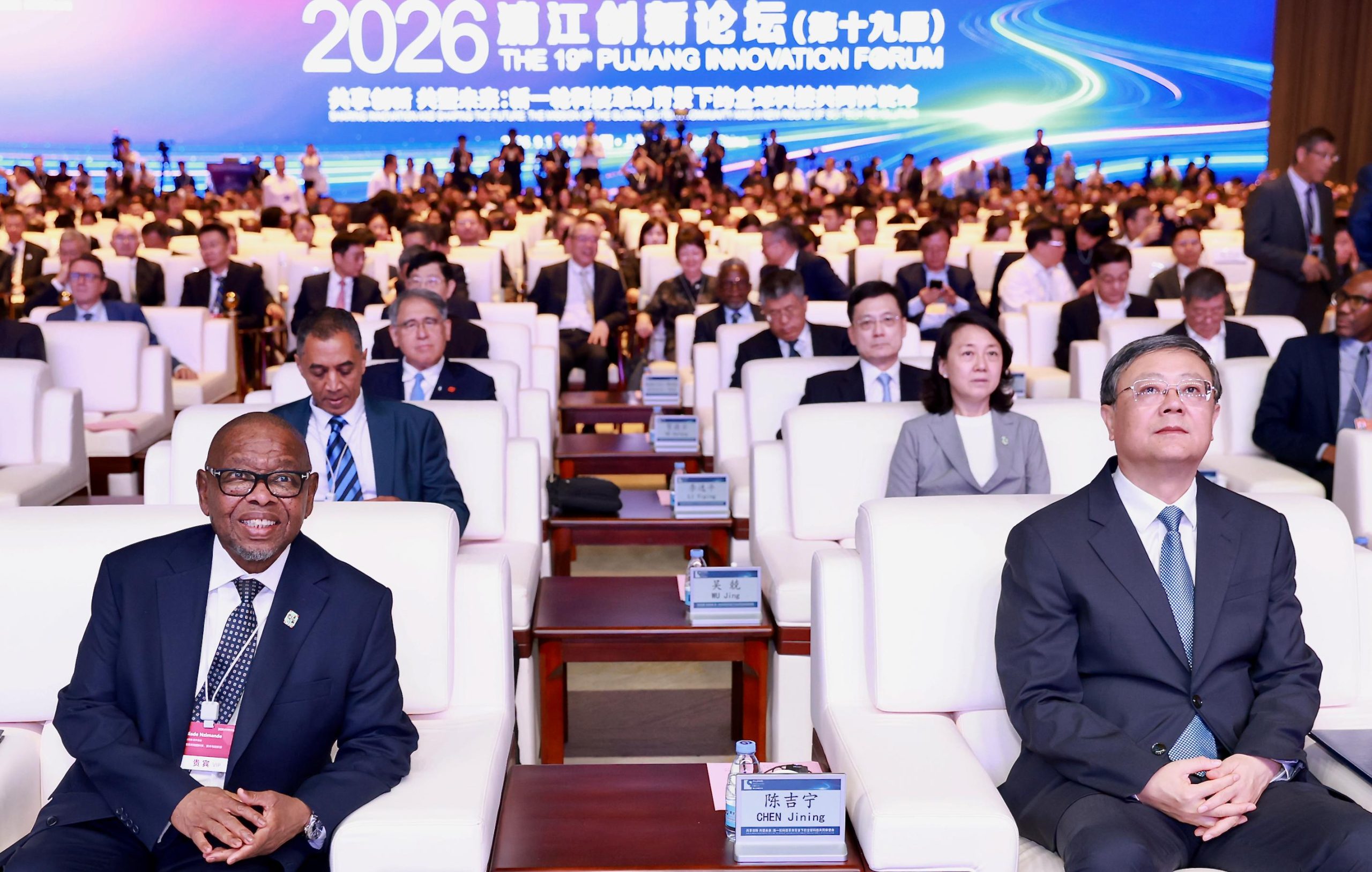
By Frans Sello waga Machate | Shanghai, China
SHANGHAI, China — South Africa’s participation in the 19th Pujiang Innovation Forum has concluded with a renewed push to translate the country’s growing science and technology partnership with China into practical cooperation in artificial intelligence, quantum computing, health innovation, energy research, talent development and technology transfer.
The conclusion of Minister of Science, Technology and Innovation Professor Blade Nzimande’s official visit to Shanghai on 12 September coincided with a significant development elsewhere in the Global South, as Chinese President Xi Jinping addressed the 18th BRICS Summit in New Delhi, India, calling on BRICS countries to assume greater responsibility in shaping a fairer, more stable and inclusive international order.
The parallel events in Shanghai and New Delhi underscored an increasingly prominent theme in South Africa-China relations: the role of science, technology and innovation in enabling developing countries to participate more meaningfully in the next phase of global economic and technological transformation.
Nzimande’s participation at Pujiang was anchored in this same question.
Addressing the opening ceremony of the forum at Zhangjiang Science Hall, the minister said that the Global South could not remain on the margins of the technological revolution driven by artificial intelligence, quantum technologies, biotechnology, space science, advanced materials and clean technologies.
His message found a strong parallel in Xi’s BRICS address, where the Chinese President said the grouping should become a pioneer in innovation-driven development as a new round of scientific and technological revolution and industrial transformation, particularly through AI, reshapes the global development landscape.
Xi called on BRICS countries to strengthen AI cooperation, promote open-source development and win-win cooperation, and deepen practical collaboration.
The technological emphasis at the BRICS Summit therefore closely complemented the discussions taking place in Shanghai, where Nzimande concluded his visit through two strategic bilateral engagements aimed at strengthening the institutional foundations of South Africa-China science cooperation.
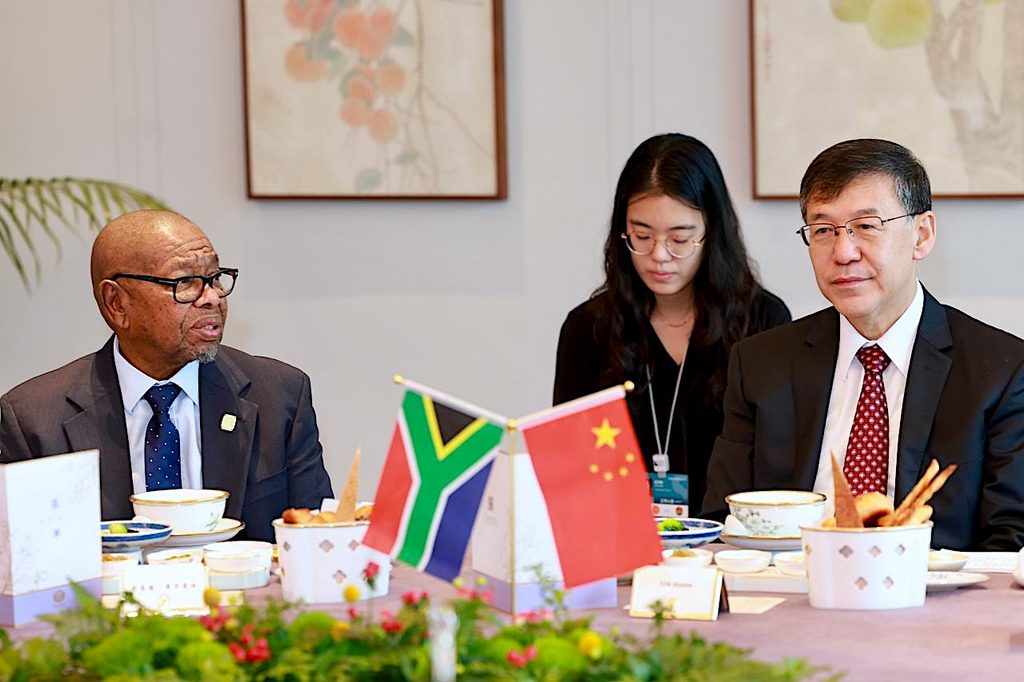
Nzimande held a high-level strategic meeting with his Chinese counterpart, Minister Yin Hejun, on the margins of the Pujiang Innovation Forum.
The discussions focused on strengthening existing scientific cooperation and identifying new areas where the two countries can work more closely.
Priority areas included artificial intelligence and quantum computing, talent and youth development, health innovation, energy research and the establishment of science and technology parks.
The two ministers reaffirmed the longstanding friendship between South Africa and China and their shared commitment to using science, technology and innovation to contribute to a more equal and humane world.
The meeting takes place against the backdrop of 28 years of diplomatic relations between the two countries and the elevation of their bilateral relationship in 2024 to an All-Round Strategic Partnership in the New Era.
The scientific relationship itself has deeper roots. In his Pujiang keynote, Nzimande recalled that bilateral science and technology cooperation is governed by the Science and Technology Agreement signed in 1999, with collaboration subsequently expanding into areas including health, traditional medicines, space science and astronomy, forestry, palaeontology and energy research.

Nzimande also met Shanghai Mayor Zhu Zhongming on Saturday, 12 September, on the sidelines of the forum with the discussions focusing on scientific, technological and economic cooperation between South Africa and Shanghai.
The meeting placed particular emphasis on the value of Shanghai’s innovation ecosystem as South Africa considers ways of strengthening its own subnational public science systems.
Both leaders framed scientific progress as a shared responsibility, calling for stronger government-to-government links, deeper cooperation between innovation institutions and increased technology transfer.
They also discussed the potential development of joint laboratories and expansion of academic exchange programmes.
The engagement provided an important practical dimension to Nzimande’s message at Pujiang that international science partnerships should produce tangible institutional and economic benefits.
The two sides also identified BRICS and the G20 as important platforms for anchoring cooperation, while discussing forthcoming economic opportunities, including South Africa’s participation in the China International Import Expo.
Nzimande formally invited the Chinese delegation to attend the South African Science Forum in December 2026, providing a further opportunity to maintain the momentum generated in Shanghai.
The significance of Nzimande’s Shanghai engagements was further amplified by Xi’s BRICS address in New Delhi, where the Chinese president called on BRICS countries to stand “on the right side of history” and act as pioneers of their times in steering the international order towards greater fairness and equity.
President Xi linked that broader vision to four major initiatives he has put forward: the Global Development Initiative, Global Security Initiative, Global Civilisation Initiative and Global Governance Initiative.
At the same time, his BRICS proposals placed considerable emphasis on the technological and industrial dimensions of cooperation. At the summit, Xi proposed initiatives covering open-source and inclusive AI, trade and investment facilitation, digital industry cooperation, intelligent manufacturing and science-and-technology talent development.
This technology agenda resonates directly with the priorities Nzimande advanced in Shanghai.
The South African minister told the Pujiang Forum that the challenge for innovators was increasingly not discovering new ideas but moving those discoveries from laboratories into markets.
“For too many innovators, the hardest journey is not from ignorance to discovery, but from discovery to market,” he said, identifying capital, market access and industrial demand as key barriers to scaling South African innovations.
That challenge is particularly relevant to the BRICS vision of deeper industrial cooperation, as emerging economies seek to develop domestic technological capabilities while remaining connected to global value chains.
The 18th BRICS Summit in New Delhi ultimately reaffirmed commitments to strengthening multilateralism, inclusive global governance, sustainable and inclusive economic growth and greater representation for emerging and developing countries.
For South Africa, Nzimande’s Shanghai visit consequently represents more than participation in a prestigious international science forum.
It demonstrated how bilateral scientific partnerships, city-to-city innovation cooperation and multilateral platforms such as BRICS and the G20 can converge around a common development challenge: ensuring that the technological revolution creates opportunities for developing countries rather than deepening existing technological and economic inequalities.
As Nzimande concluded his visit, his message was consistent with the wider direction emerging from BRICS that 'science and technology are no longer peripheral issues in international cooperation, but increasingly central to economic sovereignty, industrial development, skills formation and the future role of the Global South'.South Africa’s challenge now is to convert the partnerships and commitments advanced in Shanghai into laboratories, technologies, businesses, skilled young scientists and industrial opportunities that deliver measurable development at home and strengthen the country’s contribution to a changing global innovation landscape.
