

By Frans Sello waga Machate I Pretoria, South Africa
PRETORIA – At the heart of the Rosslyn plant launch on Friday lay a critical acknowledgment from the highest office in the land; if South Africa does not transition to New Energy Vehicles (NEVs) by 2035, it risks losing vital export markets. In Deputy President Paul Mashatile’s view, the arrival of Chery is not just an industrial acquisition; it is an urgent lifeline to the future of mobility.
“We appreciate that Chery is leading this charge in Africa with NEV options across its range,” Mashatile stated, positioning the Chinese automaker as a strategic ally in navigating the global decarbonization shift. The event, which drew approximately 600 guests for an exclusive “NEV Night” following the official launch, showcased exactly why the government is optimistic.
The evening provided the first in-person South African preview of the all-new Chery Q, a compact all-electric vehicle (EV) designed to democratize electric mobility. With a 400 km (NEDC) driving range, a 90 kW electric motor, and a 70-litre front trunk, the Chery Q challenges the perception that EVs are unattainable for the mass market.
Alongside it stood the Tiggo V, a premium lifestyle SUV that will be offered in both internal combustion engine (ICE) and hybrid derivatives. Featuring 220 mm ground clearance, a 650 mm wading depth, and multi-form seating configurations, it bridges the gap between rugged adventure and premium family comfort. Both models are slated for official launch in South Africa later this year, signaling that the Rosslyn plant’s output will be as technologically advanced as it is locally relevant.
Chery Chairman Yin Tongyue revealed the broader strategic ambition: “With the opening of the Rosslyn plant, Chery will, for the first time in Africa, present a comprehensive display of its full industrial chain ecosystem.” This constitutes a move from “product export” to “full value chain and full ecosystem international expansion.”
The ecosystem extends far beyond the factory floor. The Chery Group’s South African portfolio now spans six distinct brands: Chery, OMODA, JAECOO, Jetour, iCAUR, and LEPAS, covering passenger, SUV, and NEV segments. Notably, the Jetour T2 made history in May by becoming the first Chinese-brand vehicle to win the prestigious South African Car of the Year award.
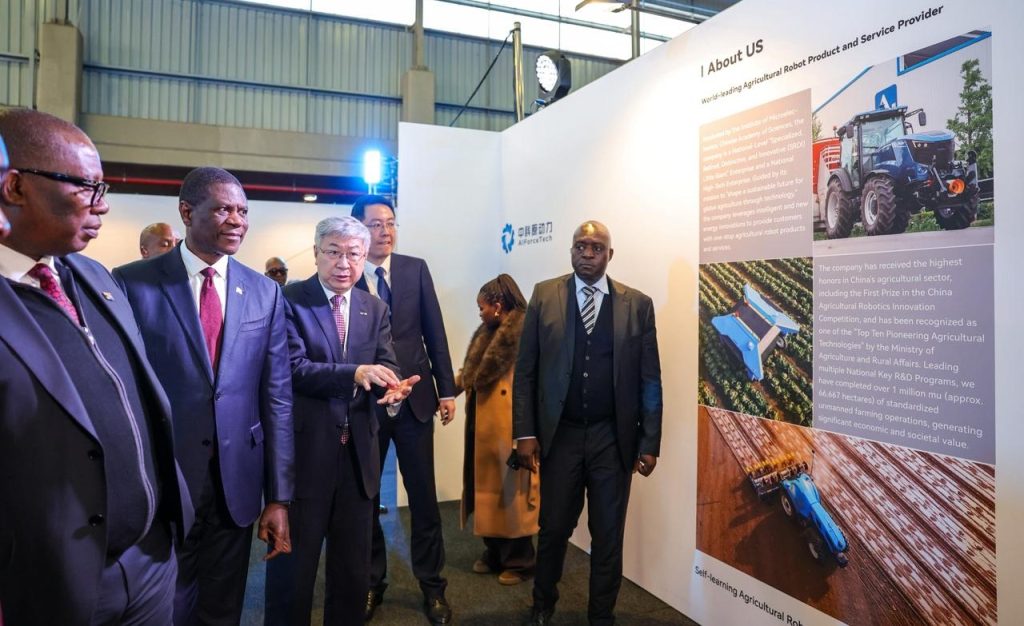
Furthermore, Chery is bringing its renewable energy photovoltaics, smart agricultural machinery, and mineral resources into the fold. This diversification is intended to drive coordinated growth across upstream and downstream supply chains, accelerating the comprehensive upgrade of Southern Africa’s automotive industry. The integration of AiMOGA Robotics, with robots deployed in over 50 countries and 100 real-world scenarios; highlights the degree of technological transfer inherent in this partnership.
Even amidst these advancements, Deputy President Mashatile issued a sobering reminder regarding the shift in market structure. “Import penetration has increased; Chinese brands have expanded rapidly in recent years, increasing their share of the domestic market,” he observed. While he welcomed the capital and technology, which are critical for the NEV transition; he urged a “state-led strategy that emphasizes the need to balance foreign investment with robust domestic safeguards.”
This means enforcing local procurement rules and improving infrastructure in energy, rail, and ports to support local suppliers. Chery has responded with a promise to meet aggressive localization targets by 2028, ensuring that while the technology may be globally sourced, the prosperity remains locally felt.
For the millions of South African motorists who will ultimately decide the brand’s fate, however, this grand industrial strategy translates into something far more personal: trust, safety, and everyday accessibility. Jay Jay Botes, General Manager of Chery International South Africa, articulated this consumer-first vision with clarity, stating that: “For the South African public, our aim is to build trust in our brand to become a household brand and also for our consumers to see that we are very rooted in South Africa.”
Botes emphasised that the company’s ambitions extend well beyond the factory gates, aiming to elevate the brand to the upper echelons of the local market. “We want to take this brand to new heights and become one of the top brands within South Africa as well,” he affirmed.
Central to this ascent is an unwavering commitment to safety and technology, pillars that Botes identified as non-negotiable standards for the Chery Group. “As Chery Group our standard is always safety, we want high tech vehicles with a lot of safety features and that is our promise to our customers. We want them to feel safe in our cars, to enjoy the tech and to be integrated as part of their life on a daily basis. That is what our product offers, obviously, at a very attainable price.”
This combination of advanced safety engineering, cutting-edge technology, and affordability; now underpinned by a local manufacturing footprint that guarantees jobs, skills transfer, and supply chain resilience, positions Chery not merely as a foreign disruptor, but as a dependable, rooted mainstay in the South African automotive landscape. The Rosslyn plant is the tangible evidence of that rootedness, a steel-and-concrete promise that the brand is here to stay, to serve, and to grow alongside the communities it now calls home.

As the guests departed the Rosslyn facility, the message was unambiguous. South Africa is not merely receiving a factory; it is gaining a partner in a technological revolution. If the Chery Q and the Tiggo V are the first fruits of this partnership, then the road to 2035, and beyond, looks remarkably electric.
