

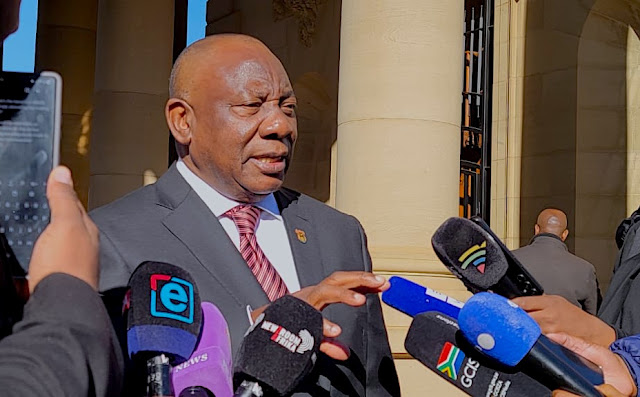
By Frans Sello Waga Machate I Pretoria, South Africa
PRETORIA, South Africa – With a critical August 1st deadline looming, South African President Cyril Ramaphosa today acknowledged the severe pressure facing the nation’s exporters from proposed US tariffs but vowed “intensive negotiations” are underway to secure exemptions and protect vital industries and jobs.
Speaking at the Union Buildings, Ramaphosa framed South Africa as a significant, yet not isolated, target in a wave of US unilateral tariff actions affecting nearly 185 nations. He emphasized that while South Africa is Africa’s largest and most industrialized economy, making it a natural focus due to substantial exports like vehicles, steel, aluminium, and citrus the government is pursuing a clear, two-pronged strategy.
“We got to respond, we export vehicles, we export steel and aluminium, we export citrus,” Ramaphosa stated bluntly. “Our task is to negotiate and negotiate as strongly and as hard we can with the United States. But at the same time we are saying to our companies that we are going to come up with some supportive measures; Our objective is really to save the jobs.”
The President stressed that South Africa has consciously chosen not to retaliate against the US tariffs, nor to decouple from the US economy. Instead, negotiations remain the primary tool. He revealed sector-specific negotiation teams are being deployed; one focusing on citrus exporters, another on automotive manufacturers, and so on, to directly address US concerns impacting each industry.
Ramaphosa adopted a measured diplomatic tone when asked about dealing with the US administration. “It is not for me to comment on whether we are dealing with people who are irrational or not,” he said. “We deal with every government with the required respect and the required dignity, we obviously expect that respect will be reciprocated.”
Crucially, the President signaled a significant strategic shift: an urgent push for export market diversification. “We should not just focus on one country, it is too risky,” he declared. “We are going to go all out to support our companies to seek other markets. We need to seek out many other markets.” He highlighted that business delegations now routinely accompany him, the Deputy President, and other ministers on international trips specifically to open new trade avenues.
Echoing the President’s urgency, Trade, Industry, and Competition Minister Parks Tau released a detailed statement reaffirming South Africa’s commitment to concluding a deal with the US before the deadline. He characterized the impasse as stemming from the “intersection of geopolitical, domestic and trade issues” requiring a “reset.”
Minister Tau provided concrete details of the proposed “Framework Deal” under negotiation, valued at over $15 billion in the following areas:
- Energy – Importing 750-1000 petajoules of US Liquified Natural Gas over 10 years ($12 billion).
- Agriculture – Simplifying US poultry access under existing quotas ($91 million) and readiness to open the market for US blueberries.
- Investment – $3.3 billion committed by SA firms in US mining, metals recycling, and joint ventures in critical minerals, pharma, and agri-machinery.
- Exemptions – Seeking crucial tariff waivers for specific sectors like shipbuilding, counter-seasonal agriculture, and small business exports (<$1m/year).
Tau confirmed the Department of Trade, Industry, and Competition (DTIC) has been engaged in “intense negotiations,” signed a “condition precedent document,” and prepared inputs for the final US template. He assured contingency planning is active, including a DTIC support desk and “demand side interventions” for impacted industries.
“This issue is an apex priority,” Tau stated unequivocally. “We have centred South Africa and her people as our non-negotiable, we will not waiver in our mission to ensure we make South Africa prosper.”
As the clock ticks towards the US deadline today, the Ramaphosa administration is projecting a dual image, a nation under economic pressure but strategically engaged, fighting hard at the negotiating table while actively building resilience through new global partnerships. The outcome of these next critical hours will significantly impact South Africa’s key industrial sectors and thousands of jobs.
