

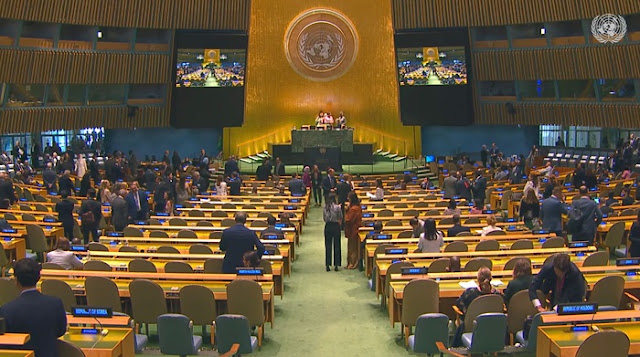
By Frans Sello waga Machate I New York, United Nations Headquarters, USA
NEW YORK – With searing condemnations of Israel’s occupation and a dire warning that Gaza has become a “graveyard of international law,” the High-Level International Conference for the Peaceful Settlement of the Question of Palestine opened today under intense pressure to deliver immediate action, not empty dialogue.
Co-chaired by French Foreign Minister Jean-Noël Barrot and Saudi Foreign Minister Prince Faisal bin Farhan Al Saud, the conference mandated by UN General Assembly Resolution 79/81 (December 2024), convened amidst global outrage over the ongoing humanitarian catastrophe in Gaza and stalled progress towards Palestinian statehood.
Originally slated for June, the rescheduled July 28-30 summit gained critical momentum days ago when French President Emmanuel Macron declared France would formally recognize a Palestinian state at the UN General Assembly in September.
“Words, speeches and declarations have little meaning to those on the ground as destruction and annexation bulldoze ahead,” declared UN Secretary-General António Guterres in a stark opening address that framed the conference as a pivotal test for the international community. “The obligation is on all of us to prove that this effort is something different. Let us reject the false choice between Palestinian statehood and Israeli security, there is no security in occupation.” Guterres emphasized that addressing Israel’s legitimate security concerns must go hand-in-hand with fulfilling “the legitimate rights of the Palestinian people.”
The dominant theme resonating through the UN hall was an urgent call for this conference to transcend rhetoric and become a catalyst for irreversible change. “Excellencies, ladies and gentlemen, for over 75 years the Palestinian people endured occupation, displacement and denial of their fundamental rights including their inalienable right to self determination,” stated Pakistan’s Deputy Prime Minister and Foreign Minister, Mohammad Ishaq Dar.
“This prolonged injustice is not just a political failure, but a moral stain. Today, Gaza is a graveyard of international law and humanitarian principles.” Dar condemned Israel’s killing of “over 58,000 Palestinians, mostly women and children,” blockade of aid, and targeting of civilians as an “unquestionable breach” of international law. “Collective punishment must stop now. We must give hope to the Palestinian people.”
Palestinian Prime Minister Mohammed Mustafa echoed the demand for decisive action, “We have been waiting for long years for a genuine international intervention. In this period of waiting, we have lost what we have lost, and we have suffered immensely.” He implored delegates.
“Let this conference be a turning point, translated into immediate and unprecedented practical steps to stop the genocide and end the Israeli occupation.” Mustafa announced Palestine’s readiness to invite a “temporary Arab and international support force,” authorized by the UN Security Council, to protect civilians, enforce a ceasefire, and support Palestinian authorities, not replace them.
French Foreign Minister Jean-Noël Barrot delivered a historic commitment: “France is ready to fully recognize the State of Palestine, and will do so in the month of September.” Framing this as both a rejection and an appeal, Barrot stated it repudiated the notion that “the war camp is winning over the peace camp,” Hamas’s denial of Israel’s right to exist, and Israeli extremists’ denial of Palestinian rights. “It is also an appeal,” he urged, “to all people and countries of the world to bring your contributions to this edifice of peace.”
The conference aims to build consensus on concrete steps towards implementing the long-stalled two-state solution based on pre-1967 borders, as enshrined in Resolution 79/81. That resolution demands Israel end its unlawful occupation, cease all settlement activities, and affirms the “illegality” of annexation attempts. It also calls for negotiations on all final status issues, including refugees and Jerusalem.
While political action dominated, the dire humanitarian situation in Gaza spurred concrete pledges. Canadian Foreign Minister Anita Anand announced $40 million in new funding; $10 million for Palestinian Authority reform and capacity-building, and $30 million “in new money this year for civilians in Gaza.”
“This will allow more aid to be pre-positioned in Jordan and the region,” Anand stated. “The Government of Canada will be present with humanitarian aid, and we will play a leading role in building bridges to more aid for Gaza.”
As delegates convened for the first plenary, the shadow of Resolution 79/81 and the recent ICJ advisory opinion condemning Israeli policies loomed large. The conference faces immense pressure to produce an “action-oriented outcome document” (per the Resolution’s Annex) that charts an “irreversible pathway” towards ending the occupation and realizing Palestinian statehood.
The message from leaders was unequivocal, incrementalism and endless process are no longer acceptable. The occupation of Gaza and the West Bank, now in its 58th year, must end. The two-state solution, backed by international law and overwhelming global consensus, is not just an ideal, it is the only viable path to security, justice, and lasting peace for both Israelis and Palestinians.
As the conference continues, the world watches to see if this gathering will indeed be the turning point leaders demanded, or merely another chapter in a decades-long saga of failed diplomacy.
